Food & drink
What Shanghai eats for breakfast: the four big names and the everyday morning menu
Breakfast in Shanghai is eaten out of the house: what the four big names actually are, the other morning items, where they are sold, and how to order.
Last updated7 min read
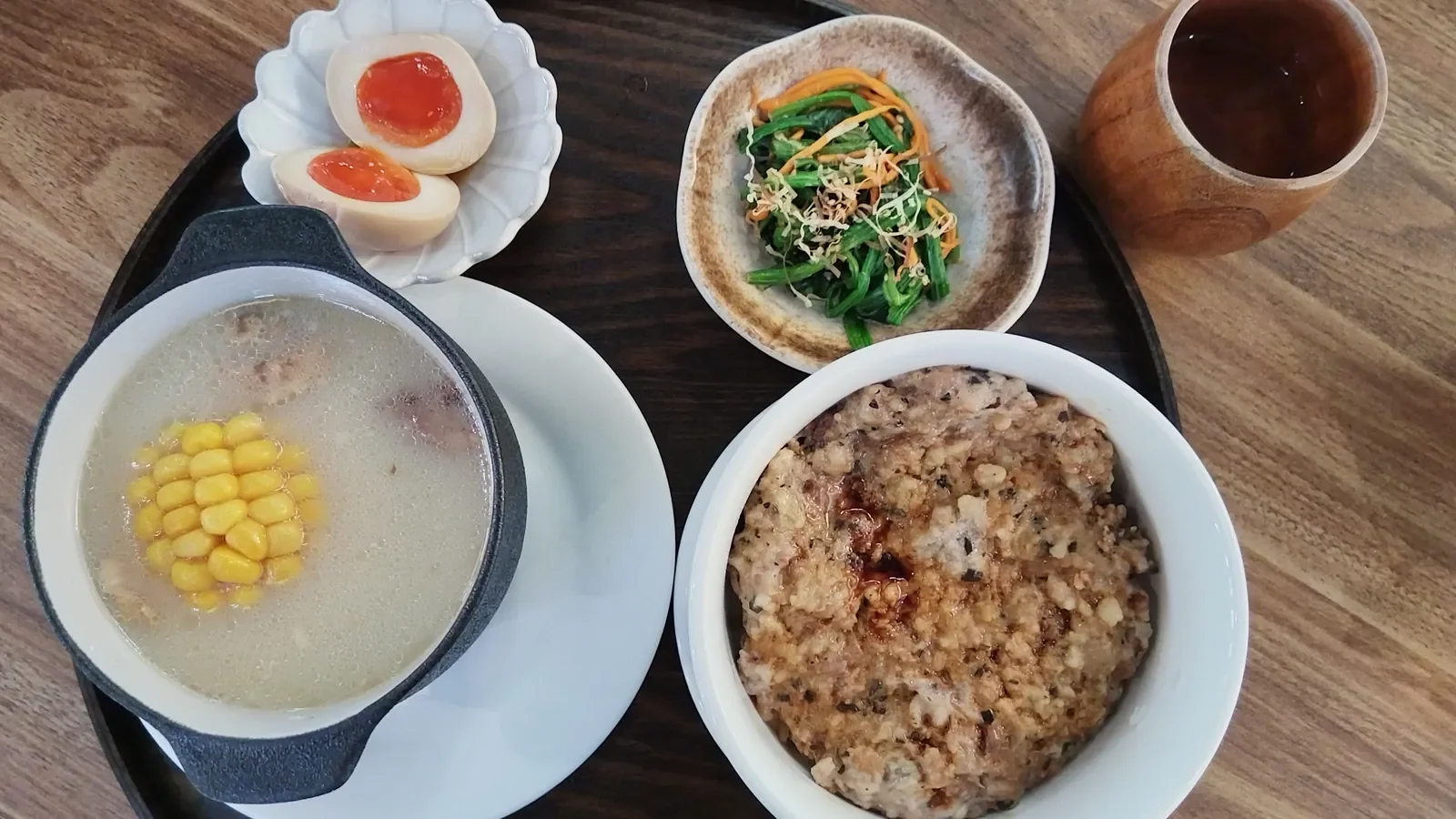
In Shanghai, breakfast is essentially eaten out of the house: between seven and nine in the morning the people on the pavement are carrying bags, and there are queues at the breakfast stalls. Almost every breakfast shop opens very early and closes around ten, so its opening hours are shorter than those of any proper meal.
The four big names — dabing, youtiao, doujiang, cifan — are what locals call the basic set. It is not the name of a shop or a fixed combo; they are four things sold separately that you put together yourself.
What the four big names actually are
| Name | What it is | How it is eaten |
|---|---|---|
| Dabing | A flat wheat cake baked stuck to the wall of an oven, in a savoury and a sweet version: the savoury one has scallion oil and salt-and-pepper, the sweet one a sugar centre | While hot, often split open and wrapped around a youtiao |
| Youtiao | A long strip of leavened dough deep-fried, two strips put in together, crisp outside and hollow within | Oily on its own; most people dunk it in soy milk or fold it into dabing or cifan |
| Doujiang | Soy milk ground and boiled on the spot, in a sweet version and a savoury one | Sugar for the sweet; the savoury one is scalding soy milk poured over soy sauce, vinegar, dried shrimp and broken youtiao. Locals mostly drink it hot |
| Cifan | Two things made from glutinous rice: the cifan roll wraps rice around youtiao, pickled mustard and pork floss and is squeezed firm; cifan gao is rice pressed into a block and fried until crisp outside and soft within | The roll is eaten one-handed on the move, the fried block while hot, usually savoury |
The most easily missed of the four is savoury soy milk. It is not “salty soy milk” so much as scalding soy milk poured over soy sauce, vinegar, dried shrimp and broken youtiao, which gives it more layers than the sweet version and makes it the commoner choice locally. Dabing goes hard as it cools, which is why the vendor bakes and sells continuously; a youtiao that has been left sitting in a pile has gone soft and tastes of nothing but oil.
The other morning items you will see
- Xiaolongbao. Small dumplings with a thin skin and soup inside, sold by the steamer, usually six or eight. Do not bite straight into the first one.
- Shengjian. Pork buns part-fried and part-steamed, crisp on the base and leavened on top. Nick a small opening first to let the steam out.
- Guotie. Fried on the base to a crisp layer, shaped like a jiaozi, with a filling close to shengjian.
- Noodles. Scallion oil noodles come without soup, and scallion oil and soy sauce are the whole dish; the soup noodles are mostly plain bowls of the yangchunmian kind.
- Wonton. Large and small; the small ones have a thin skin and a clear broth and are often ordered alongside xiaolongbao.
- Congee and buns. White congee, century egg and pork congee, blood glutinous rice congee, with pickles or fermented bean curd; meat, vegetable and red bean buns need no waiting for the next batch and can be carried away.
The three kinds of place that sell breakfast
A proper breakfast shop has seats, a menu and someone clearing tables. It opens at dawn and runs to a little after ten, with a few open all day, and the offer is mostly noodles, wonton, xiaolongbao and shengjian. It is the place to sit down and finish a meal; the drawback is that at peak times you share a table.
Street stalls and takeaway windows are the mainstay, with no seating or a few plastic stools: queue, order, pay, take it away. They are fast, and one stall often does only one or two items. The setting is genuinely the street, and most of them pack up after ten.
Convenience stores are the all-day fallback: buns, tea eggs, rice balls, sandwiches, bottled soy milk, with seats or at least a counter to stand at. Their value is reliability — you cannot arrive too late and find nothing.
How locals eat it depends on which of the three you are standing in. In a shop with seats you can sit for ten minutes over a bowl of wonton; at a stall or a window it is mostly standing. Early and fast is the common part: most people deal with it between seven and nine, and a high proportion buy and leave. The comfortable way to do it is to avoid the busiest stretch, find a shop with seats, sit down with two items and finish the soy milk.
Ordering without Chinese
The order of operations is pictures first, hands second, language last. Look for a menu with photographs, or the actual items on the counter; if there is neither, photograph the menu with a translation app. “This one” plus a finger is the single most reliable phrase, and pointing at what someone else is eating works just as well. For quantities, gesture: one finger is one portion, and pointing at a steamer basket is one basket.
On payment, note that many stalls and windows take only QR payment and will not necessarily accept cash, which the payments and money guide covers in more detail. Breakfast is usually paid for before you take the food, and at some stalls you carry your own bowl.
Sweetness, temperature, and whether it deserves a place in your itinerary
The sweetness is added sugar, not a background note. Sweet dabing, sweet soy milk and red bean buns all belong to that group, and anyone who normally eats light will probably find a first encounter too much; the good news is that savoury soy milk, savoury dabing, pork buns, shengjian, guotie, noodles and wonton are not sweet at all, so it can be avoided entirely. There is little room to adjust it, since only soy milk and the like can be ordered with less sugar or none.
The temperature of the soy milk deserves its own line: locals drink it hot, because the aroma only comes out of a scalding batch. The chilled bottled version is mostly sold in convenience stores and smells of far less.
Breakfast does not work as the main dish of a day: it is cheap, ordinary and quick. But it is the easiest meal in which to see the city’s daily life, and half an hour earlier out of bed, eating in a shop with seats in a residential neighbourhood before setting off, comes closer to local life than most paid attractions. If you want a photogenic full breakfast, or a leisurely brunch, that expectation is unlikely to be met.
What may disappoint, or be hard to find
- Some traditional items are thinning out. The ovens that bake dabing and the stalls that fry cifan gao are both declining, and their places have been taken by chains and convenience stores.
- Location and quality are mismatched. The good breakfast shops are concentrated in residential districts, while most visitors stay near sights and shopping areas; the “Shanghai breakfast” on offer near attractions is often a visitor version.
- Timing is easy to miss. Sleep until ten and set out, and everything may already have shut. This is the most common disappointment, and there is no remedy except getting up earlier another day.
- The taste gap is real. A youtiao on its own is a mouthful of oil, savoury soy milk is an unfamiliar taste to anyone not used to it, and cifan gao is a solid block of glutinous rice rather than a pastry.
- Anyone who does not eat pork has few options. Shengjian, guotie, pork buns, xiaolongbao and pork floss cifan rolls all contain pork, leaving congee, noodles, sweet soy milk, sweet dabing and some vegetable buns; strict vegetarians have a harder time of it.
To put this morning back into the city’s cooking as a whole, how to order Shanghai local food covers the proper-meal end, and the food and etiquette guide adds ordering phrases and table habits.
Related reading
Food & drink
How to order Shanghai local food: a beginner's route through a benbang kitchen
A meal of benbang cooking in four moves: recognise the sweet-savoury style, build a menu of braise, river fish, greens and soup, then work out timing and seating. Lao Zhengxing is the worked example.
5 min read